


The upgrade is not just a lifestyle decision
For many Singapore families, selling the HDB and moving into a condo feels like the natural next step. The problem is that the decision is often sold through lifestyle: a pool, a gym, a guarded entrance, a new address and the feeling of progress.
The financial reality is more precise. Before signing any Option to Purchase, an upgrader should know the cash released from the HDB sale, the CPF refund required, the condo downpayment, BSD, ABSD timing, TDSR headroom, temporary housing cost and monthly instalment shock.

Step 1: What do you actually walk away with from the HDB sale?
The most common upgrader mistake is assuming that the HDB sale price equals usable cash. It does not. Outstanding loan balance, CPF principal used, CPF accrued interest, agent commission, legal fees and admin costs all come out before you know the true cash position.
| Illustrative item | Amount | Why it matters |
|---|---|---|
| Gross HDB sale price | S$620,000 | Headline proceeds before deductions. |
| Outstanding HDB loan | Less S$120,000 | Existing loan must be settled on sale completion. |
| CPF principal plus accrued interest | Less S$210,000 to S$280,000 | CPF used for the flat, plus accrued interest, is refunded to CPF OA. |
| Agent, legal and admin costs | Less S$9,000 to S$12,000 | Transaction costs reduce actual cash available. |
| Estimated cash in hand | S$130,000 to S$180,000 | This is the cash buffer you can actually plan around. |
It is a refund back to your own CPF account. You may be able to use CPF OA again for the next property purchase, subject to CPF rules. But it is not the same as cash sitting in your bank account.
Step 2: What does the condo actually cost upfront?
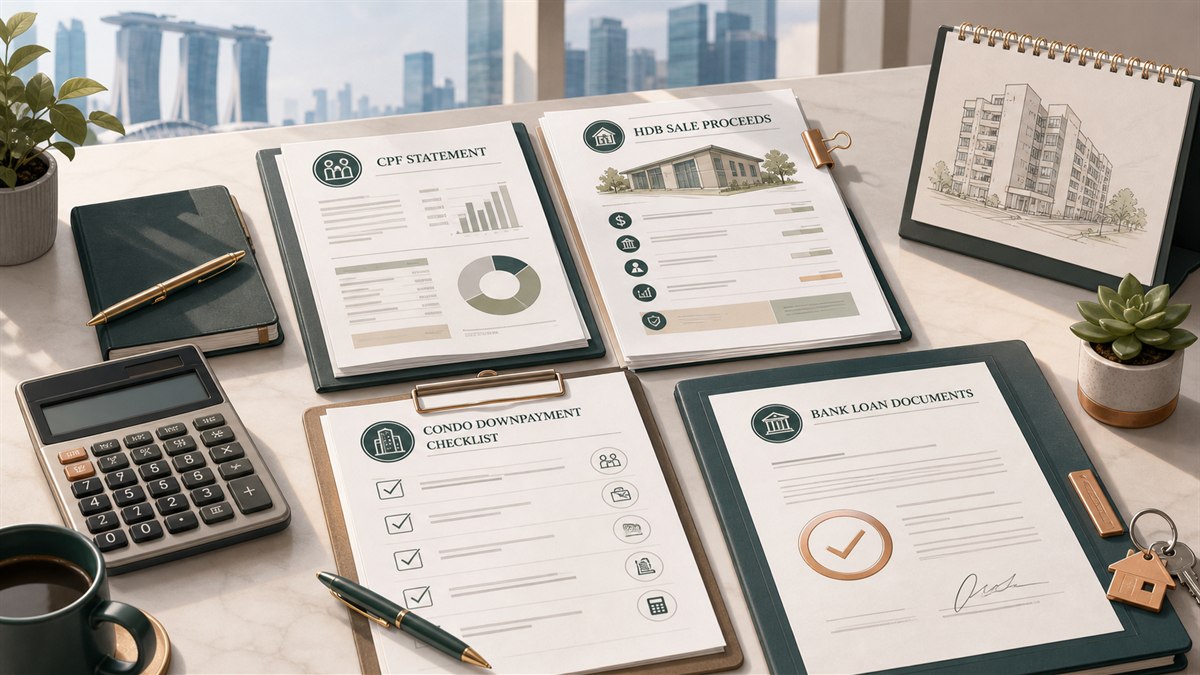
A typical upgrader moving into a S$1.6 million to S$1.8 million private condo must fund the downpayment, stamp duty, legal fees and transition costs. If the HDB is sold first, a Singapore Citizen buyer may avoid ABSD as a first private property purchase. If the condo is bought first, ABSD remission timing becomes critical.
| Cost item | Illustrative amount | Planning note |
|---|---|---|
| 25% downpayment on S$1.7M | S$425,000 | At least 5% cash, with the rest cash or CPF OA subject to CPF rules. |
| Minimum cash component | S$85,000 | Cannot be paid using CPF. |
| Buyer's Stamp Duty | About S$57,100 | Based on residential BSD progressive rates for this illustration. |
| Legal and valuation costs | S$3,000 to S$5,000 | Varies by property, bank and conveyancing scope. |
| Temporary housing and moving buffer | S$18,000 to S$40,000+ | Relevant if sale and purchase completion timelines do not align. |
Step 3: The monthly cashflow reality check
The upgrade does not end at completion. The monthly mortgage, maintenance fees, property tax and insurance will usually be materially higher than the old HDB cost base. The family should stress-test the numbers before stretching to the largest possible loan.
| Item | Previous HDB | Private condo | Impact |
|---|---|---|---|
| Monthly mortgage | S$1,500 to S$1,800 | S$4,200 to S$5,100 | Large monthly jump |
| Maintenance fee | S$80 to S$120 | S$350 to S$600+ | Often under-budgeted |
| Property tax | Lower annual value | Higher annual value | Needs annual budget |
| Loan test | MSR applies for HDB | TDSR applies for private property | More flexible, but still capped |
If the purchase only works when rates stay low, both incomes remain intact and there are no renovation or moving surprises, the upgrade is probably too tight. A practical buffer is more important than maximising the headline property price.
MortgageLogic Advisory
Speak with us before you exercise the OTP
A proper upgrader review should map your HDB sale proceeds, CPF refund, ABSD timing, bank loan quantum, TDSR headroom and monthly cashflow before you commit.
- Estimate usable cash and CPF after HDB sale completion
- Check bank loan eligibility and TDSR before shortlisting units
- Compare buy-first versus sell-first sequencing risks
- Plan the mortgage package, lock-in period and refinancing timeline
The market verdict: benchmark before you pay new-launch premium
Most HDB upgraders naturally focus on the Outside Central Region because the entry price sits closer to family budgets. But affordability is not the same as value. The premium paid for a new launch must be tested against nearby resale condos, future supply and the realistic exit market in five to ten years.
| Property route | Typical role | Upgrader caution |
|---|---|---|
| OCR new launch | Primary upgrader hunting ground | Check whether resale comparables can support the launch premium. |
| OCR resale condo | Lower quantum alternative | Watch lease age, renovation cost and maintenance history. |
| Executive condominium | Value bridge for eligible households | Income ceiling, MOP, resale restrictions and timeline matter. |
| RCR or CCR condo | Stretch option | Requires stronger income and deeper liquidity buffer. |
Location: the variable that overrides the brochure
Upgraders sometimes buy near the neighbourhood they know best. That can be a valid family choice, but it should be tested against transport, schools, amenities, incoming supply, tenant demand and URA planning context.
What supports long-term demand
- Walkable MRT access, not just "near MRT" language
- School catchment and family amenities
- Neighbourhood retail, healthcare and food options
- Clear tenant pool if rental exit is part of the plan
What can cap upside
- Heavy future supply in the same district
- Weak resale transaction depth
- Premium pricing above nearby completed projects
- Long walk to transport despite marketing claims

Unit type: do not buy bedrooms without checking square footage
Bedroom count can be misleading. A compact three-bedroom new launch may feel much smaller than the HDB flat it replaces. A larger four-bedroom may feel safer for family use, but the extra quantum raises downpayment, BSD, loan size and monthly instalments.
| Unit type | Typical upgrader use | Decision check |
|---|---|---|
| 2-bedroom or 2+study | Young couples, smaller families, budget control | Check whether it still works after one child or work-from-home needs. |
| 3-bedroom | Main family upgrader target | Compare actual size, storage, kitchen layout and study flexibility. |
| 4-bedroom | Larger or multi-generational households | Stress-test the extra S$400,000 to S$600,000 purchase quantum. |
| Dual-key | Rental offset or family privacy strategy | Validate rentability and resale depth, not just the concept. |
Developer profile: who is building your future asset?
Buying a new launch means paying today for something delivered years later. That makes developer track record part of financial due diligence, not just aesthetic preference.
Check before booking
- Completed Singapore projects and quality reputation
- Defect history and post-TOP handover feedback
- Whether a clear lead developer is accountable
- Financial standing and local delivery experience
Red flags
- Thin track record in Singapore
- Unclear joint venture accountability
- Repeated delivery or defect disputes
- Large premium justified only by showflat finishes
Who is this move really for?
Upgrading can be a strong wealth-building move when the household has enough income, liquidity and holding power. It becomes dangerous when it is driven by FOMO or a desire to match friends and neighbours.
Ready upgrader
Stable dual income, clear HDB sale proceeds, enough CPF and cash for downpayment, at least six months cash buffer and a seven-to-ten-year holding horizon.
Borderline upgrader
Income is stable but loan quantum is tight, temporary housing cost is uncertain, or the family is choosing between buy-first and sell-first sequencing.
Risky upgrader
The purchase depends on full employment, low rates, immediate price appreciation or rental income from day one.
Wait may be better
A short-term job change, new business venture, high consumer debt or weak emergency fund can make even a good property unsuitable right now.
MortgageLogic view: preparation matters more than perfect timing
The HDB-to-condo upgrade can improve quality of life and create long-term wealth. But it is also one of the largest leveraged decisions a Singapore household will make. The right question is not "can I afford the condo today?" It is "can I hold this property comfortably if rates rise, income pauses, or the resale market takes longer than expected?"
The strongest upgraders are not the ones who buy the most expensive unit. They are the ones who know their CPF refund, keep sufficient cash buffer, understand ABSD timing, choose the right loan structure and avoid turning lifestyle ambition into decade-long financial strain.
FAQ
FAQ About HDB to Condo Upgrading in Singapore
How much cash do I need to upgrade from HDB to condo?
If you take a standard bank loan at up to 75% LTV, the minimum downpayment is 25% of the purchase price or valuation, whichever is lower. At least 5% must be paid in cash, while the remaining 20% can be cash or CPF OA subject to CPF rules. You also need BSD, legal fees, moving costs and emergency buffer.
Does CPF accrued interest reduce my HDB sale cash?
Yes. CPF used for the HDB purchase, plus accrued interest, is generally refunded to CPF when the flat is sold. This does not disappear, but it changes how much sale proceeds are received as cash versus CPF OA funds.
Should I sell my HDB first or buy the condo first?
Selling first can reduce ABSD exposure and make cash planning clearer, but may create temporary housing needs. Buying first can secure the condo earlier, but requires careful ABSD remission planning and enough liquidity to bridge the transition.
Does TDSR apply when I buy a private condo?
Yes. Private property bank loans are assessed under MAS TDSR rules. Your total monthly debt obligations, including the new mortgage and existing debts, must fit within the applicable TDSR framework.
Is an executive condominium a better route for HDB upgraders?
An EC can be attractive for eligible households because entry pricing is usually below comparable private condos. However, income ceiling, MOP, privatisation timeline and resale restrictions must be considered before deciding.
